By Luis Eduardo Henao
Posted on July 16th, 2026
Air cooling has a practical limit. Industry references place it at roughly 20 to 40 kW per rack[1], depending on room architecture —containment, supply temperature and airflow design—; beyond that range, liquid cooling shifts from optional to necessary. ASHRAE, through its Technical Committee 9.9, documents this transition and recommends that every new data center be designed with the capability to add liquid cooling.[2] Between that 40 kW and the 100, 130 kW or more that AI workloads already demand, there is no air-based solution that bridges the gap. It isn’t that air is worse: it’s that, beyond a certain density, the physics simply stops working. And it’s worth saying up front, because it frames everything else: the change ahead is not about technology. It’s about architecture.
No one cools an engine with air; you cool it with liquid, which absorbs thousands of times more heat per unit of mass. Air does not disappear from the data center —it will keep cooling UPS systems, peripherals, and general room conditioning— but its role shifts: it moves from primary cooling solution to a complement handling a much smaller fraction of the load, while liquid takes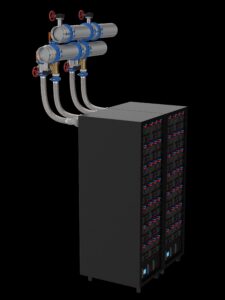 on the heat from the chips. The transition is not a decision that can be deferred at will; it is a direct consequence of the load, and that density is already on its way.
What the Leading Markets Have Stopped Debating
For years, availability was the differentiator. Tier III, Tier IV, certifications such as those from ICREA: that remains the language the industry uses to establish trust, and they are still valid references. What changed is that they went from being the ceiling to being the floor. Today’s real standard goes a step further —zero interruptions— and it isn’t reached by certifying availability alone, but by reducing components and points of failure: fewer joints, less variability, fewer things that can fail. And this is no longer a whiteboard exercise: in the markets setting the pace, campuses of 100, 300, and even 500 MW are being built, more and faster than most people realize. These aren’t pilots; they are facilities in operation, where thermal design already determines whether a data center scales or falls behind.
The Most Underestimated Component: The Piping
The instinctive fear around liquid cooling is the fluid, but the risk does not live in the water: it lives in the joint. Welded, threaded, glued, fused, or sanitary-grade pipe: each method has its place, but all of them depend on field execution, and every joint made on site is one more variable to control. More connection points mean a higher probability of failure, and the variability between installations makes it impossible to repeat a proven model. The answer is not “better pipe,” but rethinking the entire hydraulic system around three principles: prefabrication, modularity, and standardization.
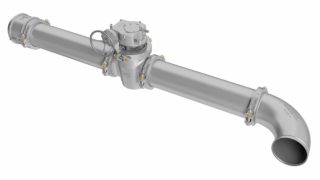
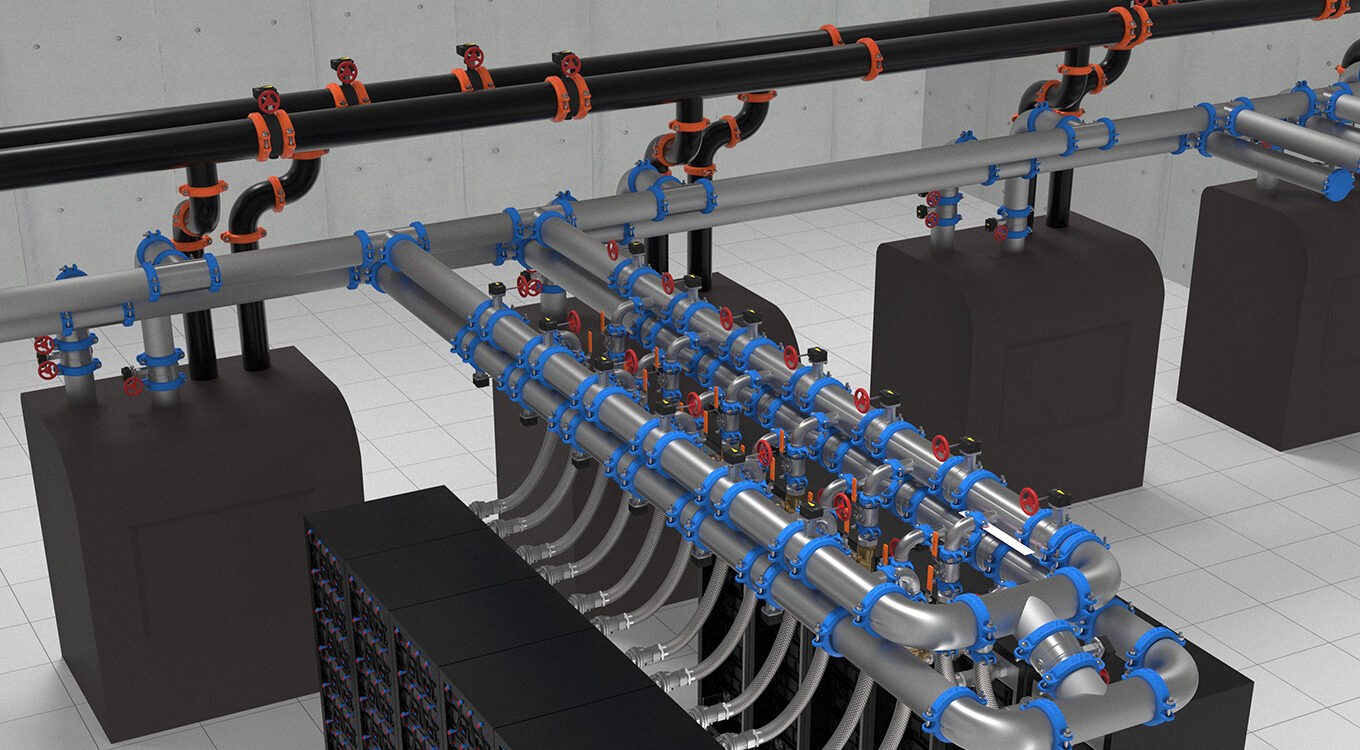
A modular system means the entire architecture —from the CDU to the in-rack couplings— is prefabricated, tested under operating conditions, and installed as repeatable blocks. Prefabricated grooved solutions make this possible: they are executed consistently, can be visually verified, and don’t depend on the individual skill of a fitter on site. And here scalability becomes a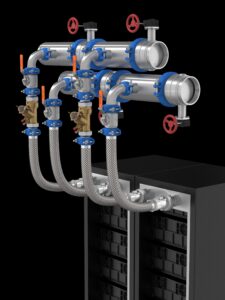 concrete operation: it isn’t just about adding modules in parallel, but about scaling the same architecture without redesigning it. When density rises, you isolate the section by closing a couple of valves and scale the manifold to a larger diameter, in the same footprint. What supports 40 kW per rack today can grow to 80 and then 120 kW on the same scheme. That is the difference between an infrastructure that gets replaced and one that evolves —and in an environment where shutting down the data center to expand it isn’t an option, being able to scale without interrupting operations changes everything.
There is one factor that is rarely discussed in design and weighs heavily on site: a single accountable party. When one manufacturer supplies the entire circuit —from the chiller outlet, through the CDU, to the rack inlet— the gray zone disappears: the one where a component from one supplier doesn’t fit another, and where the schedule slips while chasing parts from different sources. A single-source solution is the guarantee that the architecture was designed to work as a system, not assembled from parts hoping to get along.
This Is Already in Production
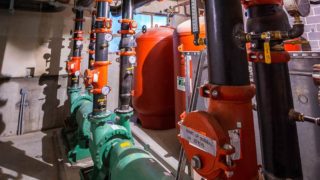
The largest AI campuses in the world —hyperscaler projects with investments in the hundreds of billions of dollars— are being built today on modular, prefabricated, and standardized thermal architectures. And Victaulic technology is part of them: it is what carries the liquid above the racks, from the main distribution down to the server inlet. On top of that, it now comes factory-integrated into several of the market’s leading CDUs, closing the full circuit under a single standard. This is not a catalog promise but a field record: since 2011, Victaulic has maintained a tracking study of its couplings in data centers around the world —more than 150,000 joints under evaluation, with over 9.4 billion hours of uninterrupted service and visual verification of their installation.
The Question for Latin America
The density already seen in those markets respects no borders: it reaches each region the moment the first serious AI workload lands. In Mexico, Querétaro and the north are already competing for power and industrial land with any mature market; in Brazil, São Paulo and Campinas are absorbing hyperscale deployments that seemed reserved for North America; in Colombia, Bogotá and the surrounding savanna are consolidating as a regional interconnection hub; in Chile, Santiago is drawing the major global operators thanks to its energy profile. And it would be a mistake to read these as isolated cases: behind them come the secondary markets, the colocation expansions, the on-prem projects that operate at 15 kW today and will need 80 kW tomorrow. The trajectory is the same across Latin America; only the calendar changes.
The decision comes down to three points: operational risk is reduced from the architecture, not by waiting for “the perfect technology”; construction time shrinks because the system arrives tested, with no surprises on site; and scalability becomes predictable, because the same architecture grows with density, without redesign and without downtime. The density is coming; that is no longer up for debate. The only thing at stake is whether the region will be ready when it does —or whether it will keep solving in the field, joint by joint, what the rest of the world already builds in blocks.
[1] ASHRAE TC 9.9, Emergence and Expansion of Liquid Cooling in Mainstream Data Centers, ASHRAE White Paper, 2021.
[2] Ranges based on industry references (e.g., Vertiv, Understanding Data Center Liquid Cooling Options; Uptime Institute). Values vary depending on each facility’s architecture.