
Posted on May 4th, 2026
Construction Safety Week 2026 (May 4–8) is built around the theme “Recognize, Respond, Respect.” And with OSHA workplace inspections dropping 20% in the first six months of 2025 compared to the same period in 2024, it is a good time to ask a harder question: where do safety decisions actually get made?
The answer, more often than not, is before anyone sets foot on the jobsite.
Industry research cited by the initiative found that workers identify only 45% of the hazards they face during pre-task briefings. More than half go unrecognized at the exactmoment they are hardest to fix. That is because many of those hazards were baked into the job long before crews arrived, shaped by the materials and systems written into the spec.
That is where specifying engineers hold real leverage.
The Earlier You Act, the More it Counts
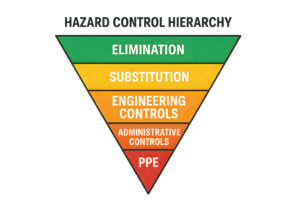
The hierarchy of controls is the standard framework for managing workplace risk, and it ranks protective measures from most to least effective. At the top is eliminating the hazard entirely. Below that: substitution, engineering controls, administrative controls and PPE. The further down that list a team operates, the more they are managing a risk rather than removing it.
Pipe-joining method is one specification decision that rarely gets reviewed through a safety lens, even though it directly shapes what crews will face during installation and maintenance. Grooved mechanical joining works by rolling or cutting a groove into pipe ends, then securing a gasket and coupling housing with standard bolts. No welding required. That single difference has real consequences for open flame exposure, struck-by risk, fall exposure and material handling.
No Open Flame, No Hot Works Hazard
Welding and soldering brings fire, explosion and fume inhalation risks onto the job. In tunnels, occupied buildings or mechanical rooms with poor ventilation, those risks compound quickly. Heat and fumes have nowhere to go, and options narrow if conditions deteriorate.
Grooved mechanical joining eliminates the ignition source, rather than asking crews to manage around it. Depending on project conditions, it can also remove the need for hot work permits and fire watch. For engineers specifying work in confined or occupied spaces, that is an entire hazard category that simply does not have to be part of the job.
Fewer Parts in the Air, Fewer Struck-By Incidents
Overhead installation means handling small components at height: nuts, bolts, gaskets and housing segments. Every loose part is a potential dropped-hardware incident. Struck-by injuries are among the most common causes of serious harm on construction sites, and the exposure grows with every floor and every connection.
Victaulic Installation-Ready™ couplings arrive pre-assembled with no loose parts, reducing the number of individual components a crew member needs to manage while elevated. On a large project with hundreds of overhead connections, fewer loose parts in the air means fewer chances for something to go wrong.
Less Time on Ladders, Less Fall Exposure
Fall protection and ladder safety violations have ranked No. 1 and No. 3 among OSHA’s most frequently cited standards for years running. Overhead work is where serious injuries happen, and time on ladders is direct exposure to that risk.
Grooved mechanical joining installs up to 10 times faster than welding and up to six times faster than flanged alternatives. On a project with hundreds of pipe connections, that speed difference translates directly into fewer trips up and down ladders and less cumulative time working at elevation. The joining method on the spec sheet has a measurable effect on how much ladder time a crew logs before the job is done.
Lighter Components, Less Strain
On large jobsites, physical strain from material handling begins before installation does. Moving fittings and components from delivery to point of use is hard work, and the cumulative load across a project with hundreds or thousands of connections spread over multiple floors is significant.
Grooved couplings are much lighter than flanged equivalents. A 6-inch flanged joint weighs approximately 51.4 pounds; the grooved equivalent weighs about 8.4 pounds, a difference of more than 43 pounds per connection. On a large project, that difference is felt in the hands and backs of everyone moving material before a wrench is ever turned.
Safety Starts at the Specification Table
The conditions crews work in are the direct result of decisions made weeks or months before installation begins. That is exactly where the hierarchy of controls says to focus.
Construction Safety Week’s “Recognize, Respond, Respect” theme applies as much at the planning table as it does on the jobsite. With enforcement less predictable than it was a year ago, the responsibility to build safety into project design falls more directly on the teams doing the specifying.
For engineers looking to review the safety data for Victaulic products, the full library of Safety Data Sheets is available.